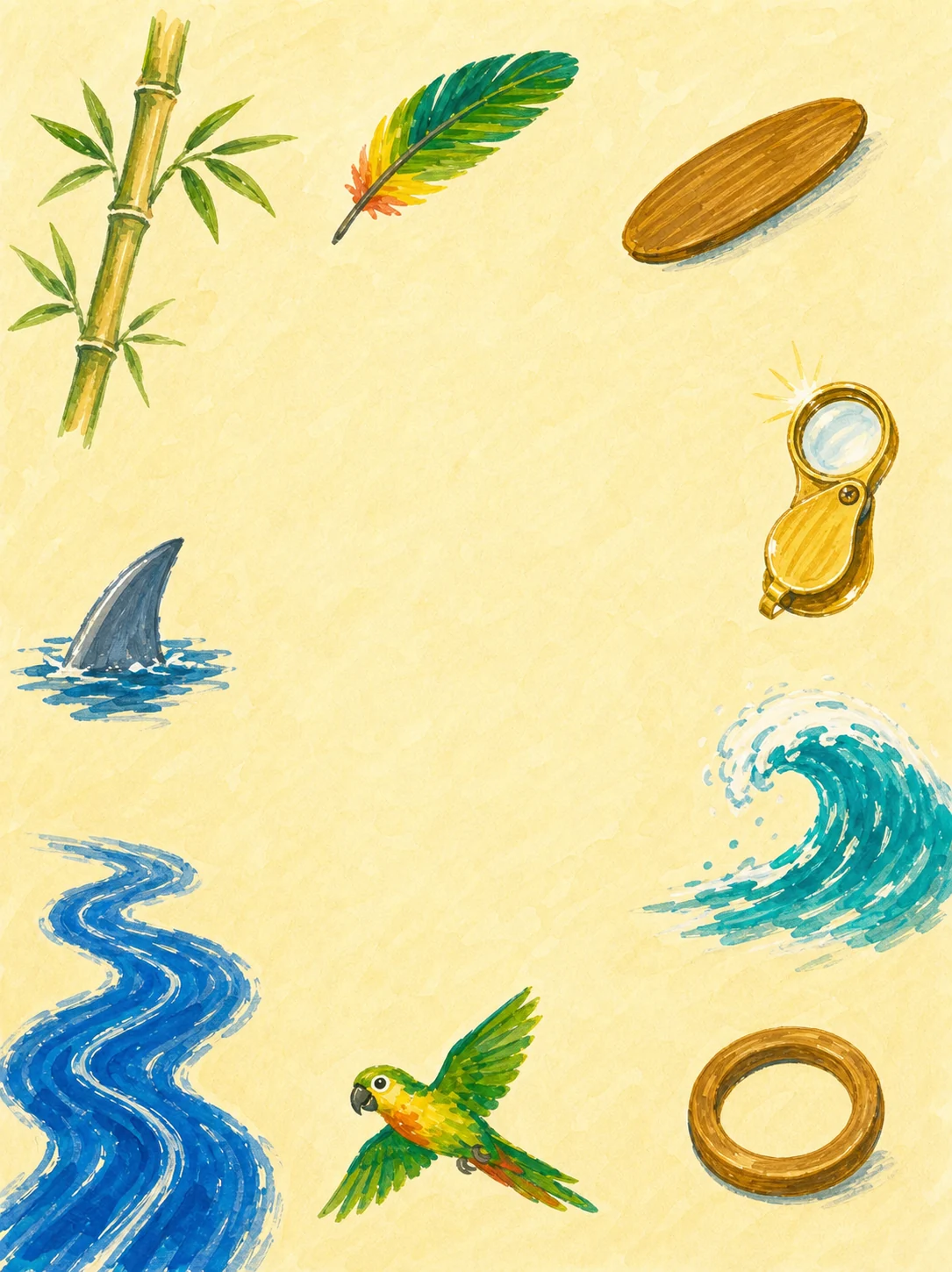
Legend
Bamboo — a tall grass with a hollow stem, hard and light. Good for kite frames, fishing poles, and — if you are clever and careful — little rings for a bird's foot.
Conure — a small, bright parrot with a very big voice and a very big heart. Conures fly far, remember faces, and are curious about absolutely everything, especially shiny things. A pineapple green-cheek conure has a tan head, a sunny yellow chest with a red-orange blaze, and a brick-red tail.
Demigod — someone half-person and half-god. Stronger and cleverer than most, but not quite as safe as a god — and, once in a while, in need of a friend.
Māui — a hero of Hawaiian and Polynesian legend. He fished whole islands up out of the sea, slowed the sun, brought fire to people, invented the kite, and kept the winds in a gourd. He is clever, and brave, and sometimes a little too sure of himself.
Manō — the Hawaiian word for shark. In Hawaiian tradition sharks are not only dangerous but sometimes ʻaumākua — ancestral guardians who watch over a family. So a shark can be a monster, a teacher, or a protector, depending on the story. All three are true in this one.
Paipo — a small, flat wooden bellyboard for riding waves lying down. Older and simpler than a surfboard, and a very good friend to have in the ocean.
Surfing the shark — in this book, Wind's own name for a wild, dangerous trick. There is a real old Hawaiian word close to it: lelewaʻa, "canoe-jump" — said to be the practice of leaping onto a shark's back and riding it to shore in place of your canoe. Wind would have approved, to extend Lele Kawa.
Lele Kawa — a physical test of courage and loyalty often demanded of young warriors and chiefs. It involved cliff diving — specifically leaping from coastal cliffs up to 80 feet high into the ocean below without splashing. King Kahekili II of Maui famously popularized this as an ultimate trial to test his warriors' bravery.
Pineapple Waterway — a great current that flows through the sea like a road, always one direction. You cannot see its edges, but you can feel it pull. It carries whatever the ocean decides to carry.
Rip current — a strong, narrow river of water running away from the shore. It is how a calm sea can carry a swimmer out fast. If it ever catches you: don't fight it. Keep your head up, and — watch and think.
Shortfin Mako — the fastest shark in the whole ocean. Sleek, silver, and always hungry. Its nose is so full of feeling that a good bump can leave it dizzy. Not a friend. But a fine teacher, if you live.
The island — no, sharks do not really gather around one island like that. This one was an anomaly. One can imagine that it was bought by a very wealthy lawyer who loved Makos more than was sensible, kept them, in great netted pools all around her island. After one stormy day the lawyer was never seen again, only her island and a few very well-fed sharks appear in the story. Sophie of course went to that island to search for Wind, but she was late by a day.